
#88: Magic Bus by The Who
City: Toronto, ON
Radio Station: CHUM
Peak Month: August 1968
Peak Position in Toronto ~ #1
Peak Position in Vancouver ~ #12
Peak Position on Billboard Hot 100 ~#25
Peak Position on New Zealand Singles chart ~ #13
YouTube: “Magic Bus”
Lyrics: “Magic Bus”
The Who are an English band who emerged in 1964 with singer Roger Daltry, guitarist Pete Townshend, bassist John Entwistle, and drummer Keith Moon. The band enjoyed popular singles, such as “I Can See For Miles”, “Pinball Wizard” and “Won’t Get Fooled Again”. In Vancouver the band had eleven Top Ten hits, while in the UK they charted fourteen singles into the Top Ten. But in America, between 1965 and 1982, the Who only charted one single – “I Can See For Miles” – into the Top Ten of the Billboard Hot 100. The band were innovators of new genres in rock n’ roll with their rock operas Tommy and Quadrophenia. The Who early on were known for outlandish antics on stage. At the Railway Hotel in Wealdstone, England, in June, 1964, Peter Townshend destroyed his guitar on stage and smashed it into other instruments. The Who stand alongside The Beatles and The Rolling Stones as among the most influential rock bands from Britain. They had their first Top Ten single in the UK and in Vancouver in 1965 titled “I Can’t Explain”, which peaked at #8 in the UK and #2 in Vancouver.
Roger Daltry was born in East Acton, a suburb of London, in 1944. He learned how to play guitar and became the lead singer and lead guitarist for a skiffle band called The Detours, in 1959. He worked as a sheet metal worker by day and musician by night. After their first hit single Daltry’s bandmates in The Who kicked him out of the band after he beat up Who drummer Keith Moon for providing drugs to Pete Townshend and John Entwistle. Daltry had to assess his strategy for dealing with conflict with others. Seven days later, Daltrey was allowed to return to the band, but he had to be put on probation. Daltry swore that he wouldn’t be physically violent anymore. He later reflected, “I thought if I lost the band I was dead. If I didn’t stick with The Who, I would be a sheet metal worker for the rest of my life.”
Peter Townsend was born in West London in 1945. Born into a musical family, Townshend learned to play guitar at the age of eleven. He and a schoolmate, John Entwistle, formed a traditional jazz group called the Confederates where Townshend played banjo and Entwistle played horn. John Entwistle joined Roger Daltry’s band, The Detours, in 1961. And soon after suggested Pete Townsend join the band. In 1964 there was another regional band named The Detours and so Daltry’s band came up with a new name, The Who.
John Entwistle was born in Cheswick, a suburb of London. From the age of seven be began to learn piano and then went on to learn the trumpet, French horn and guitar. He played with Pete Townsend in the Confederates and later joined Roger Daltry’s band, The Detours, in 1961.
Keith Moon was born in 1946 in Central Middlesex and grew up in the Greater London suburb of Wembley. He initially learned the bugle while in Sea Cadets at the age of twelve, but soon moved on to learn the drums. He was part of a band in the early 60s called The Escorts, but by the end of 1962 Moon had moved on to join the instrumental band, The Beachcombers. At age seventeen he auditioned for and got the position as drummer for The Who.
The Who were one of a number of classic rock ‘n roll bands from the UK who were part of the British Invasion. Others who were part of that wave include The Yardbirds, The Kinks, Cream, The Hollies, The Troggs, Manfred Mann and the Small Faces.
“I Can’t Explain” was the first single released by The Who. Their next single, in the winter of 1965 was called “My Generation.” It peaked at #2 in the UK, but only climbed to #74 in the USA. Several more singles that did well in the UK included “I’m A Boy”, which reached #2. Two months later The Who released “Happy Jack“.
June 16-18, 1967, the Monterey International Pop Festival was held in Monterey, California. The festival featured many popular rock n’ roll artists and debuted Janis Joplin, Jimmy Hendrix, Otis Redding and The Who to a large American audience. At the end of their set Pete Townsend smashed his guitar and Keith Moon kicked over his drum-set. Following their appearance at Monterey, The Who went on tour with Herman’s Hermits as the opening act. According to Dave Marsh in his book Before I Get Old: The Story of The Who, the band added to their notoriety for violence while on this tour. It was in a hotel in Flint, Michigan, that the band caused $24,000 worth of damage to their hotel room. The band had a summer hit titled “Pictures Of Lily“. In the midst of growing stardom, born of both musical success, live performance antics and unflattering news stories, The Who released “I Can See For Miles”.
The Who went on to chart another 14 singles into the Top 20 in Vancouver into the 1980’s. The first of these was “Call Me Lightning”, a hit in the spring of 1968. In the summer of 1968, the band released “Magic Bus”.
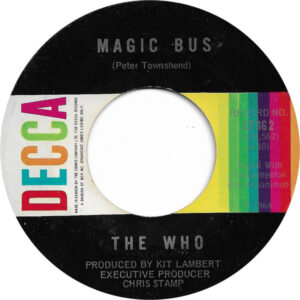
Pete Townsend wrote “Magic Bus”. The song is about a man who wants to buy the bus that he takes to get to his girlfriend every day, but the driver does not want to sell it. The guy riding the bus recounts, “Every I get in the queue, to get on the bus that takes me to you.” When he gets to the bus stop near his girlfriend’s house, he says to the bus driver “I don’t want to cause no fuss. But can I buy your magic bus?” In the interlude the narrator insists “I want it. I want it. I want it. I want it.” But the driver replies “You can’t have it.” But by the fourth verse, the narrator sings “Now I’ve got my magic bus. I drive my baby every way. Each time I go a different way.”
“Magic Bus” peaked at #1 in Toronto, Los Angeles, Akron (OH), and Hamilton (ON), #2 in Fresno (CA), Dallas, and Orlando, #3 in Santa Rosa (CA), Jackson (TN), Clovis (NM), and Cleveland, #4 in Winnipeg (MB), Abilene (TX), Buffalo, Miami, Fort Lauderdale, Cincinnati (OH), Omaha (NE), Vancouver (WA), Rochester (NY), and San Diego, #5 in Calgary, Houston, Sarasota (FL), Wilkes-Barre (PA), Chicago, Danville (IL), and San Francisco, #6 in St. Thomas (ON), San Jose (CA), Saint Charles (MO), Manchester (NH), Salem (OR), and Jackson (MI), #7 in Lansing (MI), Racine (WI), Davenport (IA), and Syracuse (NY), #8 in Ann Arbor (MI), and Corpus Christi (TX), #9 in Oklahoma City, #10 in San Bernardino (CA), and Billings (MT), #11 in Windsor (ON).
Internationally, “Magic Bus” reached #6 in Canada, #13 in New Zealand, #25 on the Billboard Hot 100, and #26 on the UK pop singles chart.
They went on to record a rock opera, Tommy. From the album came “Pinball Wizard”, “I’m Free” and “See Me, Feel Me”. Another hit was “Substitute“.
The Who later had hits with “Squeeze Box”, “Who Are You” and “Won’t Get Fooled Again”. One of the last Top 40 hits for the Who was in 1980 with “You Better, You Bet”.
Drummer, Keith Moon, died in 1978 and was replaced by Kenny Jones through to 1988.
The Who have released eleven studio albums, their last – Endless Wire – in 2006. That year the Who single “”Wire & Glass” was a Top Ten hit in Canada. Roger Daltry and Pete Townsend remain the core of The Who, with a backing band that tours with them. In August and September 2025, The Who went performed concerts as part of their The Song Is Over: The North American Farewell Tour.
November 4, 2026
Ray McGinnis
References:
The Story of The Who, The Who.com
Pete Townsend, “Meaty, Beaty, Big and Bouncy: Pete Townshend on the Who’s ‘Tommy’,” Rolling Stone, December 9, 1971
Andy Greene, The Who Bio, Rolling Stone.com.
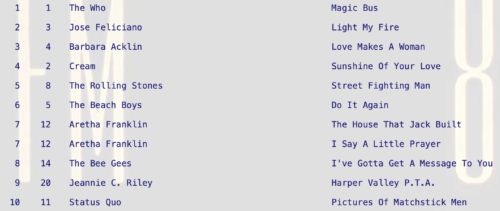
CHUM 1050-AM Toronto (ON) | August 31, 1968
Leave a Reply