
#42: Lovers In A Dangerous Time by Bruce Cockburn
City: Regina, SK
Radio Station: CJME
Peak Month: July-August 1984
Peak Position in Regina ~ #12
Peak Position in Vancouver ~ #19
Peak Position on Billboard Hot 100 ~ did not chart
YouTube: “Lovers In A Dangerous Time”
Lyrics: “Lovers In A Dangerous Time”
Bruce Cockburn was born in Ottawa in 1945. He has stated in interviews that his first guitar was one he found around 1959 in his grandmother’s attic, which he adorned with golden stars and used to play along to radio hits. Some of these included songs by the Beau Marks from Montreal. Later he was taught piano and music theory by Peter Hall, the organist at Westboro United Church which Cockburn and his family attended. Cockburn had been listening to jazz and wanted to learn musical composition. Hall encouraged him and, along with his friend Bob Lamble, a lot of time was spent at Hall’s house listening to and discussing jazz. After graduating, he took a boat to Europe and busked in Paris. Cockburn attended Berklee School of Music in Boston, where his studies included jazz composition, for three semesters between 1964 and 1966. That year he dropped out and joined an Ottawa band called The Children, which lasted for about a year.
In early 1967 he joined the final lineup of the Esquires. He moved to Toronto that summer to form The Flying Circus with Marty Fisher and Gordon MacBain, and Neil Lillie. The group changed its name to Olivius, and opened for the Jimi Hendrix Experience and Cream in April 1968. In the summer of 1968, Cockburn joined 3’s a Crowd until he left to pursue a solo career in the spring of 1969. Cockburn’s first solo appearance was at the Mariposa Folk Festival in the town of Caledon in 1967, which he headlined in 1969 when it moved to Centre Island in Toronto.
In 1970, Cockburn released a self-titled debut album, and the single “Going To The Country”. He won the Juno for Canadian Folksinger of the Year, three years in a row, from 1971 to 1973. He was nominated for Canadian Folksinger of the Year and Male Vocalist of the Year at the 1974 Juno Awards. His first charting single on the RPM Canadian Singles chart was in 1971 with “One Day I Walk”. By the mid-70s, Cockburn was penning songs with obvious political commentary. His 1975 single, “Burn”, included these lines about American foreign policy: “Philippines was yesterday. Santiago and Greece today. How would they ever make the late news pay, if they didn’t have the CIA?”
In 1979 he had a hit on both sides of the Canada-US border with “Wondering Where The Lions Are”. It climbed to #21 on the Billboard Hot 100 and #39 on the RPM Canadian Singles chart. The single charted on the CKLGplaylist in Vancouver for nine weeks.
In the early 1980s, Cockburn had more Top 40 hits in Canada, including “Rumours Of Glory”. While “Fascist Architecture” topped the Canadian Adult Contemporary chart in 1981. The following year, “You Pay Your Money and You Take Your Chance” was a Top 30 Adult Contemporary chart hit in Canada.
In 1983, Cockburn released his twelfth studio album titled The Trouble With Normal. The title track was released as a single. His next release was “Lovers In A Dangerous Time”.

Cockburn stated that “Lovers In A Dangerous Time” was inspired by seeing teenagers expressing romantic love in a schoolyard. In the song, he contrasts the hopefulness and joy of new love with the despair of a wider Cold War world where notions of the future often carried a sense of foreboding and doom. Others have suggested the Guatemalan Refugee Crisis, and the emerging HIV/AIDS crisis were also part of the ‘dangerous time’ lovers were facing into the 80s.
Dear reader, do you consider our present time as a ‘dangerous time?’ Or not? What case could you make for our present time being ‘dangerous?’ Are there factors pointing to their being little cause for alarm?
“Lovers In A Dangerous Time” climbed to #2 in Denver, #3 in Annapolis (MD), #4 in Cleveland, #5 in Boston, #7 in Rensselaer (NY), #9 in Austin (TX), #12 in Regina (SK), #13 in Ottawa, #15 in Toronto, and #19 in Vancouver (BC).
In 1984, Cockburn’s “If I Had A Rocket Launcher” commented in the brutal repression of Guatemalan dictator Rios Montt toward the Guatemalan peasants. It became a Top 30 hit in Toronto.
In 1986, Bruce Cockburn had his third RPM Top 40 charting single with “People See Through You”. In 1988, Cockburn released his sixteenth studio album, Big Circumstance. The lead single from the album was “If A Tree Falls”.
In the 1990s, Bruce Cockburn charted four more singles into the Canadian Top 40 with “A Dream Like Mine” (RPM #16 – 1991), “Great Big Love”, “Listen For The Laugh” (RPM #18 – 1994) and “Night Train”. Over the years, Cockburn’s music drew in Latin, rock and reggae beats, layered over folk lyrics. In 2001 Cockburn performed as part of the Music Without Borders concert, a benefit for the United Nations Donor Alert Appeal, which raised funds for refugees from Afghanistan, at the Air Canada Centre in Toronto.
In 2014, Bruce Cockburn released his memoir, Rumours Of Glory. In 2018, Cockburn’s album Bone on Bone, was named Contemporary Roots Album of the Year at the Juno Awards. Over the years, Bruce Cockburn has been an advocate raising awareness of the plight of child soldiers, expressing concern for the environment, banning land mines, and the welfare of indigenous peoples. The latter includes his concern for the land claims of the Haida Gwaii.
Bruce Cockburn released his 28th studio album, O Sun O Moon, in May 2023.
October 9, 2026
Ray McGinnis
References:
Bruce Cockburn, Rumours Of Glory, HarperOne, 2014.
Eva Wasney, “‘Loyal friend’: Cockburn receives key to city on 50th anniversary of first folk fest appearance,” Winnipeg Free Press, July 13, 2025.
Peter Robb, “Bruce Cockburn is living in Frisco,” Ottawa Citizen, May 20, 2014.
Mike Devlin, “Bruce Cockburn steps out, with the weight of the world upon him,” Victoria Times-Colonist, March 17, 2025.
“Machine Of The Year 1982: The Computer Moves In,” Time, October 5, 1983.
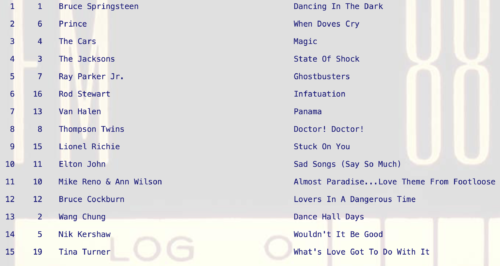
CJME 1300-AM Regina (SK) | August 4, 1984
Leave a Reply