
#7: Old Man by Neil Young
City: St. Thomas, ON
Radio Station: CHLO
Peak Month: May 1972
Peak Position in St. Thomas ~ #3
Peak Position in Vancouver ~ #16
Peak Position on Billboard Hot 100 ~ #31
YouTube: “Old Man”
Lyrics: “Old Man”
Neil Young was born in Toronto in 1945. His family moved to Omemee, Ontario, and he contracted polio in 1951, two years before the polio vaccine was introduced. He learned guitar and dropped out of high school. He played in the Winnipeg based band called The Squires, who toured parts of Manitoba and northern Ontario. They played instrumental covers of Cliff Richard’s backup band, The Shadows. Young moved to California in 1966 where he was a founding member of the Buffalo Springfield. In 1968 he released his self-titled debut studio album. And in 1969 he became the fourth member of Crosby, Stills, Nash & Young.
In an article by TIDAL, it’s pointed out that “Neil’s dad, journalist, sportswriter and author Scott Young, is considered to be a national icon in Canada. He wrote over 30 books in his career, amongst others the 1952 schoolboy favorite, Scrubs on Skates. The book was dedicated to his sons: “To Neil and Bob, whose greatest games are still ahead of them.” Neil’s mother, Edna Blow Ragland “Rassy” Young, divorced Scott Young in 1960. She took Neil with her to Winnipeg. That year, Neil Young formed a band called The Jades. In order to get around to performances, Neil purchased a 1948 Buick Roadmaster hearse. He nicknamed his hearse Mortimer Hearseburg, or Mort, for short.
On the day he turned nineteen, Neil Young composed “Sugar Mountain” on November 12, 1964. He was in Fort William, Ontario, at the Victoria Hotel. After his band the Squires had packed it in Young sat down to write 126 verses for”Sugar Mountain.” It would be a four year wait before he would record a few of the verses to “Sugar Mountain” on November 10, 1968. This was as part of a concert in the college town of Ann Arbor, Michigan, at Canterbury House. The song was a solo hit for Young in 1971.
In 1966, Young drove to Los Angeles in his second hearse, a 1953 Pontiac, after Mort broke down. It happened that Stephen Stills was in a car in and spotted Neil Young stuck in traffic on Sunset Boulevard. The two got together and formed Buffalo Springfield.
Buffalo Springfield released their self-titled debut album in December 1966. Their third single, “For What It’s Worth” spent 15 weeks on the Billboard Hot 100 and peaking at #7. The song was about an incident during August 1966 on the Sunset Strip in Hollywood. Residents of the area had attempted to get rid of the hippies near the Pandora’s Box club, who they saw as a threat to local tourism, by having the police enforce curfew laws. A riot ensued and police began to wield night-sticks on the long-haired youth.
Stephen Stills had seen the riot after returning from a trip to Nicaragua. Stills was inspired: “All the kids on one side of the street, all the cops on the other side – in Latin America that meant there’d be a new government in about a week. ” The song became an anthem for a generation wary of the status quo who began wearing buttons that read “question authority.” Near the peak of its chart run of “For What It’s Worth” Buffalo Springfield had an appearance on The Smothers Brothers Comedy Hour was taped on February 26, 1967.
Their second album, Buffalo Springfield Again, was released in November 18, 1967. It was not an easy album to record due to tensions between band members. Neil Young, who had his first epileptic fit while performing with the band in 1966, was often absent. Bass guitarist, Bruce Palmer, was detained on drug charges and was sent back to Canada on several occasions delaying the deadlines for the albums release.
Among the notable tracks are Young’s minor hit, “Mr. Soul“, which was the B-side to the Buffalo Springfield’s debut single from the album, “Bluebird”. Stephen Stills contributed four tunes, among them “Rock and Roll Woman”. Simultaneous tension in Buffalo Springfield, The Byrds, and The Hollies would eventually result in the formation of Crosby, Stills & Nash.” In 2003, Buffalo Springfield Again was ranked number 188 on Rolling Stone magazine’s list of the “500 greatest albums of all time.” A final album, Last Time Around, was released in 1968. It included the single, “On The Way Home“.
Neil Young recalls of the time of the breakup of Buffalo Springfield, “I just couldn’t handle it towards the end. It wasn’t me scheming on a solo career, it wasn`t anything but my nerves. Everything started to go too fucking fast. I was going crazy, joining and quitting, joining and quitting again. I began to feel like I didn’t have to answer or obey anyone. I needed more space. That was the big problem in my head. So I’d quit, then I`d come back ‘cos it sounded so good. It was a constant problem. I just wasn’t mature enough to deal with it. I was very young. We were getting the shaft from every angle, and it seemed like we were trying to make it so bad and getting nowhere.”
Young went onto be part of the supergroup, Crosby, Stills, Nash and Young. Originally Crosby, Stills & Nash – with a Top Ten hit in 1969 titled “Suite: Judy Blue Eyes” – they added Neil Young for the recording of their album Déjà Vu in early 1970. Significantly, Young provided lyrics and lead vocals for “Helpless” and “Country Girl”. Déjà Vu was a huge hit, climbing to number-one in several international album charts, and spending 88 weeks on the Billboard 200 Album chart. Classic hits from the album included a cover of the Joni Mitchell song “Woodstock”, “Teach Your Children” and “Our House”.
But again, Neil Young found himself at odds with members of the band. Though he collaborated with the others on subsequent albums into the mid-70s, Young focused on his solo career. Young wrote “Ohio” in response to the shooting in Kent State in May 1970. The song’s opening line “Tin soldiers and Nixon’s coming…” became an anti-war protest anthem. In April 1970, Neil Young released “Cinnamon Girl”. The single appeared on CKVN in Vancouver (BC) in late June ’70.
In 1972, Neil Young had his most successful hit, “Heart Of Gold”. It climbed to #1 in both Canada and the USA in 1972. A followup single, “Old Man” made the Top Ten across Canada.
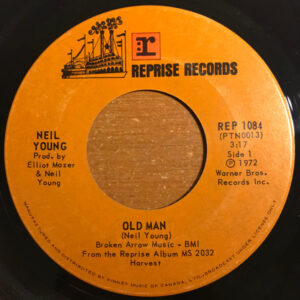
In 2006, Neil Young told an interviewer in the documentary Neil Young: Heart of Gold the following about “Old Man”. “About that time when I wrote “Heart of Gold”…I was touring. I had also – just, you know, being a rich hippie for the first time – I had purchased a ranch, and I still live there today. And there was a couple living on it that were the caretakers, an old gentleman named Louis Avila and his wife Clara. And there was this old blue Jeep there, and Louis took me for a ride in this blue Jeep. He gets me up there on the top side of the place, and there’s this lake up there that fed all the pastures, and he says, “Well, tell me, how does a young man like yourself have enough money to buy a place like this?” And I said, “Well, just lucky, Louie, just real lucky.” And he said, “Well, that’s the darndest thing I ever heard.” And I wrote this song for him.” Broken Arrow Ranch, which Neil Young purchased, is south of San Francisco. Young’s ranch, where Louis Avila worked, on Bear Gulch Road, spanned 140 acres in the rural hills between La Honda and Half Moon Bay, southwest of Redwood City, California. The property took its name from Young’s Buffalo Springfield song “Broken Arrow,” released in 1967. After he divorced his wife, Peggi, the ranch went to her in the 2014 divorce settlement.
In “Old Man”, Neil Young asserts his life resembles the ‘old man’ (Louis Avila) life when he was young like Neil is now ’24’ years-old. Young sings he “lives alone in a paradise” which is Broken Arrow Ranch. Young sings “love lost, such a cost.” He married his first wife, restaurant owner Susan Acevedo, in December 1968. They were together until October 1970, when she filed for divorce. In the lyrics, Neil Young steps outside of the narrative between himself and the ‘old man,’ to ask his audience about his own fame: “Does it mean that much to me, to mean that much to you?” He considers that in his life “I’ve been first and last.” So, Young is aware that while he is temporarily ‘first’ – in the spotlight and on the top of the pop charts – he’s also been ‘last’ (recently divorced), and may be in other ways as well in the coming years.
Linda Ronstadt and James Taylor sang backing vocals on “Old Man” on the 1972 recording of “Old Man”. In 2008, the song was chosen to be played after a eulogy at the memorial service for 28-year-old actor Heath Ledger with a slideshow of pictures from Ledger’s life. (An autopsy concluded the actor died from accidental abuse of prescriptions).
“Old Man” has appeared in the comedy-dram Wonder Boys (2000), the skateboarding culture film Lords of Dogtown (2005), and the comedy film Due Date (2010).
“Old Man” peaked at #3 in St. Thomas (ON), San Diego, and Nashville (TN), #5 in Palatine (IL), #6 in New Orleans, Hemingway (SC), and Honolulu, #8 in Toronto, Sioux Falls (SD), and Wilmington (DL), #9 in Joliet (IL), Springfield (IL), and Omaha (NE), and #10 in Seattle.
He also released another anti-war song titled “War Song“. Highly critical of President Richard Nixon and the Vietnam War, the single made the Top Ten in Vancouver (BC). in 1974 Young had another Top 20 hit on the West Coast with “Walk On“.
Since 1975 Neil Young has received 28 Juno Award nominations and won seven of these. He has also won a Grammy Award for Best Boxed or Special Limited Edition Package for his compilation album Neil Young Archives Vol. 1 (1963–1972). Young has had a number of regional hits over the years. In the late 70s he released a cover of the Ian & Sylvia tune “Four Strong Winds”.
In 1985 Young appeared in the charity single “Tears Are Not Enough” by Northern Lights. Young was one of a number of solo vocalists in the song, along with Gordon Lightfoot, Burton Cummings, Anne Murray, Joni Mitchell, Dan Hill, Bryan Adams, Corey Hart, Bruce Cockburn, Rush frontman Geddy Lee, and Loverboys’ Mike Reno.
In 1993 his single, “Harvest Moon” climbed to #5 on the Canadian RPM singles chart, but missed the Billboard Hot 100.
In 2003, Young had a biography penned by James McDonough titled Shakey. Over the decades, Neil Young has expressed his politics in song. A critic of the Bush family in America, Young’s 1989 hit “Rockin’ in the Free World” criticized the policies of George H.W. Bush and the epidemic of drug use and homelessness. Young’s 2006 album, Living With War had one track after the other lambasting President George W. Bush and his administration. Some of the song titles included “Looking for a Leader” and “Let’s Impeach the President”.
Over the course of his career, Neil Young has released 42 solo studio albums. He has been nominated for 26 Grammy Awards, winning on three occasions – most recently for Best Rock Song in 2011 for “Angry World”. Young has also been nominated for a Juno Award on 28 occasions, winning seven times.
Young recorded “A Rock Star Bucks A Coffee Shop” in response to Starbucks’ possible involvement with Monsanto and use of genetically modified food. The song was included on his 2015 concept album The Monsanto Years.
In September 2020 Neil Young released an EP titled The Times. He invited President Donald Trump to play Young’s song “Lookin’ For A Leader” at his rallies.
In 2023, Young and actress Daryl Hannah travelled by train to Victoria on short notice to offer their support to 1,200 Old Growth activists who had been arrested unlawfully at the Fairy Creek old-growth logging protests. Young played a short set to draw attention to the issue, and hearten the activists, some of whom had been pepper sprayed and assaulted by RCMP officers, trying to protect the last at-risk intact watershed of Old Growth in southern British Columbia.
August 26, 2026
Ray McGinnis
References:
“Neil Young bio,” Rolling Stone, New York.
70 Facts You Might Not Know About Neil Young, TIDAL, June 17, 2016.
McDonough, James. Shakey: Neil Young’s Biography. Vintage, New York, 2003.
Brian Ray, “Neil Young with Crazy Horse – Cinnamon Girl (1969),” A Bit Like You And Me blog, June 8, 2012.
“Tears Are Not Enough, Solo Vocalists in Order,” Wikipedia.org.
Chris Deville, “Neil Young – “A Rock Star Bucks A Coffee Shop,” Stereogum, May 22, 2015.
Brian Gibson, “Neil Young House Tour: Inside the Legendary Broken Arrow Ranch,” Home Decor, London, UK, 2025.
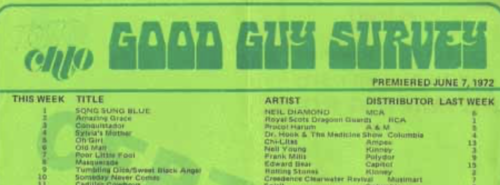
“Old Man” #6 week of June 7, 1972, and #3 week of May 31, 1972.
Leave a Reply