
#2: Artificial Flowers by Bobby Darin
City: Sudbury, ON
Radio Station: CKSO
Peak Month: November 1960
Peak Position in Sudbury ~ #1
Peak Position in Vancouver ~ #17
Peak Position on Billboard Hot 100 ~ #20
YouTube: “Artificial Flowers”
Lyrics: “Artificial Flowers”
Walden Robert Cassotto was born in the Bronx in May, 1936. His mother, born in November 1917, was pregnant with him when she was only sixteen, giving birth to him when she was seventeen. In the 1930’s, being a pregnant teenager was very improper. So she gave birth and was introduced to her son as his older “sister.” In order for the deceit to be pulled off, young Robert was raised by his grandmother, Polly, who he understood was his mother. And he understood that his “mother” had given birth at a later stage in life. His “mother” was a showgirl in her earlier days and so not the “grandmother type.” So the ruse was successful. It was not until 1968, when he was 32 years of age, that he discovered that his older sister, Giovannina Cassotto, was actually his mother. In his childhood, Robert learned to play piano, drums and guitar. According to his biographies, Walden Robert Cassotto suffered from rheumatic fever as a child. Bobby’s real sister, Vivienne, said years later, “my earliest memory of Bobby as a child was about his rheumatic fever. We couldn’t walk on the floor because just walking across the floor would put him in agony. I remember Bobby crying and screaming and my father having to pick him up and carry him to the bathroom, he was in so much pain. I remember being told all my life, “Bobby’s sickly. You have to be careful, and you have to protect him.” Between the ages of eight and thirteen, Bobby had four illnesses with rheumatic fever. Each one damaging his heart muscle more severely than the previous illness.
Bobby was told that his father was Sam Cassotto, who took a fall for the Mafia and died in prison before Bobby was born. But his older “sister” Giovannina, got quickly involved with a guy named Charlie Mafia who moved in with Polly, Bobby and “Nina.” Nina and Charlie got married a few years later. The way this was explained to Bobby was that Charlie was his new brother-in-law. The young boy began to compose rhyme, sing and play child instruments by the age of six. As he spent long absences from school when he was ill, he spent time amusing himself developing an interest in music. Since he had a bad heart, he couldn’t play sports like the other kids at school or in the neighborhood. Since Bobby was confined to bed for long periods, his “mother,” Polly, home schooled him and told him about being a showgirl and the entertainment business. Bobby perceived that the family was very poor, a perception reinforced since they lived in a poor Italian ghetto in the Bronx. But his sister Vivienne, recalls they got the first Television on the block. In any event, Bobby dreamed that a career in the music business could get him beyond his life in the Bronx.
After a year at Hunter College where he studied drama, Bobby got hired by Don Kirshner to work at the Brill Building in 1955 as a demo writer and a demo singer under the pen name, Bobby Darin. Robert Cassotto had met Kirshner at a candy store in Washington Heights. In 1956 Darin recorded his first record, “Rock Island Line”, followed by “Silly Willie” credited to Bobby Darin and the Jaybirds. Another song Bobby Darin wrote in 1956 was a novelty tune titled “I Want Elvis For Christmas”, recorded by the Holly Twins, featuring vocals by Eddie Cochran. Darin had a regional #3 hit in the summer of 1957 in Buffalo, New York, with his recording of “I Found A Million Dollar Baby”. This was a cover of a Harry Warren tune made famous by Bing Crosby in 1931 who charted the song to #2. One of the recording artists Bobby Darin wrote for was Connie Francis. They began to date, but Francis’ father didn’t approve and the relationship ended.
In 1958 Darin, who was with Decca Records, got a deal with Atco, a subsidiary of Atlantic Records. He wrote a song titled “Splish Splash, Take A Bath”. The song title was shortened to “Splish Splash”. When it was released it became a million seller, peaking at #2 on the Cashbox Top 100 Singles chart, and topped the pop chart on CKWX in Vancouver. Darin had another Top Ten song listed on the Top 100 for the year of 1958 called “Queen Of The Hop” (#9 Billboard, #7 on CHUM in Toronto and #2 on CKWX in Vancouver). Next, Darin had his biggest hit, so far in early 1959, with “Dream Lover”. It peaked at #1 in the UK, #2 in the USA, #5 in Norway, and #12 in Belgium. Its best chart run in Canada was in Ottawa where it peaked at #1.
But no one was prepared for the surprise success he had in 1959 with his cover of a 1956 song by Louis Armstrong titled “Mack The Knife”. The song was an English translation of Bertolt Brecht’s lyrics “Die Moritat von Mackie Messer” from the 1928 musical, Die Dreigroschenoper (or The Threepenny Opera in English). First performed in English in 1933, The Threepenny Operahad a run at an off-Broadway theater in 1954. One verse from the song, “There are some who are in darkness/And the others are in light/And you see the ones in brightness/Those in darkness drop from sight,” was not included in either the Armstrong or Darin recordings. With “Mack The Knife” earning Darin the Grammy Record of the Year, he earned the respect of the adult listening audience. He also won the Grammy Award for Best New Artist.
In Canada, “Mack the Knife” topped the pop charts in Calgary, Edmonton, Hull (PQ), Midland (ON), Montreal, Moose Jaw (SK), Red Deer (AB), Regina, Toronto, and Vancouver. Internationally, “Mack the Knife” topped the pop charts in Canada, the UK and USA, reached #9 in Norway, #11 in Belgium, and #14 in the Netherlands.
In 1959, Bobby Darin also began performing in night clubs at the age of 23. These included the Copacabana in Manhattan and the Flamingo in Las Vegas.
Bobby Darin had a string of Top 40 hits in the early 1960’s that were covers of songs from across the previous century. These included “Beyond The Sea”, a remake of a French song called “La Mer”, by Charles Trenet, from 1947. Darin took “Beyond the Sea” to #2 in Winnipeg, and was a Top Ten hit in Canada, the UK, and USA.
In 1960, Darin followed up with a jazzy rendition of the folk ballad “Clementine“. Darin’s revised lyrics have Clementine reimagined not as someone light as a fairy, but as a 299-pound woman. After she falls into the water, Darin suggests that Clementine could be mistaken for a whale and calls out to those on the high seas to watch for her, in a rhythm and style reminiscent of Darin’s rendition of “MacK The Knife”: “Hey you sailor, way out in your whaler, with your harpoon and your trusty line. If she shows now, yell… there she blows now. It just may be chunky Clementine.” Bobby Darin’s cover of “Clementine” reached number-one in Hull, Quebec.
Later in the spring of 1960, Bobby Darin revived an old Dixieland chestnut from 1902 titled “(Won’t You Come Home) Bill Bailey”. It was a Top Ten hit in Ottawa. He had a minor hit with “Beachcomber” in late summer of 1960. This was followed with a treatment of “Artificial Flowers” from the Broadway musical Tenderloin.
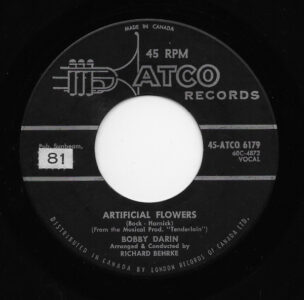
The plot in Tenderloin concerns Reverend Brock, a single-minded 1890s social reformer works to sanitize the Tenderloin, a red-light neighborhood in western Manhattan. He is foiled by everyone associated with the district, including the corrupt politicians and police who are taking their cut from the earnings of the prostitutes who work the streets there. Tommy Howatt, a writer for the local scandal sheet Tatler, infiltrates the minister’s church and proceeds to play one side against the other, eventually framing Brock by revealing to the authorities his plan to raid the brothels, but ultimately saving him by siding with him at his trial. As a result, the Tenderloin is shut down and Brock, asked to resign from his church, heads for Detroit with the hope of succeeding there as well.
In Tenderloin, Reverend Brock and Jessica Havemeyer, the clerk at the church Parish House, sing the tale about “poor little Anne” who is “alone in the world.” She is orphaned because “her parents had gone to their final reward” (we don’t know why) “leaving their baby behind.” Anne was only “nine years old” when her parent died. The lyrics detail how Anne “bravely worked at the one thing she knew to earn her few pennies a day making artificial flowers…fashioned for ladies of society to wear.” Anne works with paper and shears, wax and wire, to make each artificial tulip and mom. But as “snowflakes drifted into her tenement room, her baby little fingers grew numb.” The artificial flowers were “made from Annie’s despair.” It happens that one day “they found little Annie all covered with ice still clutching her poor frozen shears.” Rev. Brock and Jessica Havemeyer imagine “there must be a heaven where little Annie can play in heavenly gardens and bowers. And instead of a halo she’ll wear round her head a garland of genuine flowers.” By the end of the song, radio listeners and theatre goers become attached to “poor little Annie” and in sympathy with the wish for her heavenly reward.
Tenderloin received three Tony Award nominations. One for Maurice Evans (Best Actor in a Musical) who played Rev. Brock. But he lost out to Richard Burton in Camelot. The next nomination was for Ron Husmann (Best Featured Actor in a Musical) who played the ambitious reporter Tommy Howatt. But he lost out to Dick Van Dyke in Bye Bye Birdy. A third Tony Award nomination went to Cecil Beaton for Best Costume Design in a Musical, but won by Camelot.
The composers of “Artificial Flowers” were Jerry Bock and Sheldon Harnick. Jerrold Lewis Bock was born in 1923 in New Haven (CT), and was raised in Queens (NY). He studied piano as a child. While at university in Madison (WI), Bock wrote the musical Big As Life, which toured the state and enjoyed a run in Chicago. After graduation, he spent three summers at the Tamiment Playhouse in the Ponocos and wrote for Your Show of Shows variety show on NBC (from 1950 to 1954) with lyricist Larry Holofcener. One of their songs, the three-part “The Story of Alice,” was performed by the Chad Mitchell Trio on their Blowing’ in the Wind album of 1962.
In 1955, Bock and Holofcener contributed songs for the Broadway musical Catch a Star. In 1956, they wrote songs for the Broadway musical Mr. Wonderful, and worked on the Ziegfeld Follies of 1956.
In 1958, Bock teamed up with Sheldon Harnick to write the musical The Body Beautiful (along with Will Glickman). Their 1959 Broadway musical about New York City mayor Fiorello La Guardia, Fiorello!, earned them a Pulitzer Prize for Drama, and seven Tony Award nominations. They won in the categories for Best Musical (tied with The Sound of Music), Best Performance by a Featured Actor in a Musical, and Best Direction of a Musical.
Bock and Harnick’s next broadway musical was Tenderloin. Bock and Harnick had further successes with She Loves Me (1963). The musical earned them five Tony Award nominations, and winning in the category for Best Performance by a Featured Actor in a Musical. When it was revived on Broadway in 1993, the musical earned nine Tony Award nominations and won one in the Best Actor in a Musical category. In 1964, the songwriting team wrote Fiddler on the Roof. It was nominated for ten Tony Awards, winning nine. These included Best Musical, Best Producer, Best Director, and Best Composer and Lyricist. In 1966, The Apple Tree received seven Tony Awards, winning one.
In 1970, Bock and Harnick’s Broadway musical The Rothschilds received nine Tony Award nominations. This included a Best Original Score nomination for Bock and Harnick. They lost to Stephen Soldheim’s Company. Still The Rothschilds won two Tony Awards for Best Performance by a Leading Actor in a Musical and Best Performance by a Featured Actor in a Musical. Jerry Bock died three weeks short of his 82nd birthday in November 2010.
In 1993, Sheldon Harnick’s Cyrano: The Musical received four Tony Award nominations, including Best Original Score. Over the decades, Sheldon Harnick wrote lyrics for 27 Broadway productions (together with Bock, and separately). His final musical was in 2016 titled Lady Bird: First Lady of the Land. He died at the age of 99 in 2023.
Artificial Flowers may conjure the image of plastic flowers in a vase at a cheap restaurant. However, artificial flowers have a history going back to ancient Egypt. In Rome, winners of athletic events were given artificial leaves with gold and silver adornments. An article on more recent history of making artificial flowers in the 18th Century states “they used hot irons to press out the petal shapes and then stitched the flowers together…using balls of wax to stabilise the flower heads. In 1700s Paris, most flower-makers either trained as or worked alongside fashion merchants and feather-makers, meaning that their expertise lay in sewing, the manipulation of fine fabrics, and paring and trimming feathers. Flower-makers might have lacked skills or the equipment to dip wire in hot wax to create pollen-filled anthers, and would have instead used the materials with which they were familiar to create blossoms from fabric and feathers…” In writing about artificial flowers and the process of making them, Zara Kesterton writes it is “fiddly and painstaking…to try and imitate the delicacy of natural flowers, while still creating something sturdy enough to withstand being handled or even worn.”
In London, England, artificial flower-making was at its height in 1891. That year there were 4011 flower makers in London. Workers each created petals which had to be assembled into flower shapes, held in place with a stalk of twisted wire. The stalk was covered with paper or silk, and the flowers were arranged for bouquets or ladies hats. Work that didn’t require tools was done at home, often by women and children of poor families. These beautiful objects which decorated expensive clothes and hats were often produced by sweatshop labour. In England, “the Children’s Employment Commission found that the majority of females assembling artificial flowers were under eighteen years of age, with some starting as young as eight. Factories would employ over a hundred flower-makers at a time, working between twelve – and at the height of demand – eighteen hours a day.”
On the NYC Historic Floral District website it is stated that flower-makers in the 1890s into the 1900s made $3.60 a week for a six-day workweek, while working 11 to 12 hours a day. In other words, flower-makers in Manhattan were earning $60 cents a day at five cents an hour.
“Artificial Flowers” peaked at #1 in Sudbury (ON), #2 in Schenectady (NY), #4 in Spokane (WA), Des Moines (IA), and New Haven (CT), #5 in Denver, Salt Lake City, Boston, Davenport (IA), and Manchester (NY), #6 in Buffalo, Washington DC, #7 in Rockville (MD), Rochester (NY), and Albany (NY), #8 in Salem (OR), #9 in New York City, and #10 in Toronto.
Another unlikely Top 20 hit for Bobby Darin was is remake of the 1930 hit, “Lazy River”, by Hoagy Carmichael. Darin also did a cover of the 1948 hit by Nat King Cole, “Nature Boy”.
Bobby Darin was endearing himself across the teen-adult divide as he drew from opera, off-Broadway shows, pioneer songs, Dixieland and classic pop standards. But in 1962, he missed the Top 40 with his remake of the 1926 tune, “Baby Face”, a #1 hit that year for Jan Garber. Bobby Darin’s interest in old songs was likely influenced by the influence of Polly, who raised him and had been a showgirl doing Vaudeville.
In addition to his recording career Darin was also making movies. In 1959, Darin had an uncredited cameo appearance in a film called Shadows about interracial dating. In 1960 he appeared in a comedy titled Pepe, and also sang while the credits rolled at the end of the film Tall Story.
In 1961, Darin covered the pop standard “You Must Have Been A Beautiful Baby”, originally from the 1938 film Hard to Get. Bobby Darin had the biggest chart success with the song which became a Top Ten hit in Canada, the UK and the USA that year.
In 1961 Bobby Darin starred in Come September. The romantic comedy found Darin acting alongside Rock Hudson, Gina Lollobrigida and his first wife, Sandra Dee. The movie and featured the song “Multiplication”, which climbed the US pop charts to #30 and #7 in Vancouver. Between 1959 and 1973, Bobby Darin either acted and/or sang a song for a film in eighteen productions. His most acclaimed role was at Corp. Jim Tompkins in the film, Captain Newman M.D. in 1963 which earned him an Academy Award nomination for Best Supporting Actor.
Meanwhile, Darin changed musical direction in 1962 with country-pop songs “Things”, “You’re The Reason I’m Living” and “18 Yellow Roses”. The latter was a hit in the spring of 1963. With the British Invasion, Bobby Darin was kept out of the Top 40 in the USA until his Top Ten hit, “If I Were A Carpenter”, in the fall of 1966. After that, south of the border, his single releases sputtered in the lower rungs of the Billboard Hot 100. One of these, “She Knows“, was a Top Ten hit in Vancouver.
Darin became actively involved in the 1968 presidential candidacy of Robert Kennedy and believed in the Massachusetts senators’ platform. In Kennedy’s campaign, Darin made appearances on behalf of the candidate and also worked to help Kennedy in the primaries. Kennedy’s assassination in June 1968 had a deep effect on Darin. For a time, he dropped out, quit working, sold some of his possessions, and moved to a mobile home at Big Sur, California. In late August 1968, he sold his music publishing company, T.M. Music, to Commonwealth United Corp. for $1 million.
In late October 1968, he debuted a new protest song, “Long Line Rider”, at the Cocoanut Grove, changing his dress in mid-show from tuxedo to denim jacket. Two months later, in January 1969, he appeared at New York’s Copacabana with a four-piece rock band performing “Long Line Rider”. A few weeks later, he walked off the TV set of the Jackie Gleason Show after he was prohibited from singing “Long Line Rider”. A “long line rider” was a prison guard, often on horseback, who supervised inmates on prison farms and work details in the rural South. Darin’s song highlighted the terror reported at the Arkansas Cummins Prison Farm, where three skeletons of former prisoners were reportedly discovered in January 1968.
In 1969, Tim Hardin covered the anti-war song “Simple Song of Freedom” which Bobby Darin wrote and recorded the previous year.
In July 1972, Bobby Darin starred in an NBC TV show titled Dean Martin Presents: The Bobby Darin Amusement Company. It ran from July 1972 to January 1973. In the early 1970’s his health was beginning to fail, as he had always expected, following bouts of rheumatic fever in childhood. This knowledge of his vulnerability had always spurred him on to exploit his musical talent while still young. He died at 37, following a heart operation in Los Angeles late in 1973.
In 2004 a film about Bobby Darin’s life, Beyond The Sea, was a minor box office hit. In 2016, in Australia, Dream Lover: The Bobby Darin Musical, premiered in Sydney. Bobby Darin has a star on the Hollywood Walk of Fame.
August 28, 2026
Ray McGinnis
References:
Jack Doyle, “Dream Lover 1958-1973,” pophistorydig.com, May 26, 2008.
Dodd Darin and Maxine Paetro, Dream Lovers: The Magnificent Shattered Lives of Bobby Darin and Sandra Dee… (Warner Books, 1994).
Bobby Darin – info, Bobby Darin.net
Bobby Darin, Rock & Roll Hall of Fame
Behind the Song: Oh My Darling Clementine, Singing the Song in My Heart.com, September 2, 2015.
Baby Face (1926 song), Wikipedia.org
(Up A) Lazy River, Wikipedia.org.
Tenderloin, Music Theatre International.
Captain Newman M.D., Rotten Tomatoes.com.
Robert F. Kennedy speech (excerpt), June 4th-5th, 1968, Ambassador Hotel, Los Angeles, CA.
Kevin Spacey – director, Beyond The Sea, Lionsgate Films, 2004.
Dream Lover: The Bobby Darin Musical, Dream Lover.com.au.
Robert Berkvist, “Jerry Bock ‘Fiddler on the Roof’ composer, Dies at 81,” New York Times, November 3, 2010.
Robert Berkvist, “Sheldon Harnick, ‘Fiddler on the Roof’ Lyricist, Dies at 99,” New York Times, June 23, 2023.
Zara Kesterton, “Cultivating research skills: artificial flowers and the process of making,” Doinghistoryinpublic.org, May 5, 2025.
“The Lost Victorian Art of Flower Making,” HK Floral.
“Our History,” NYC Historic Floral District.
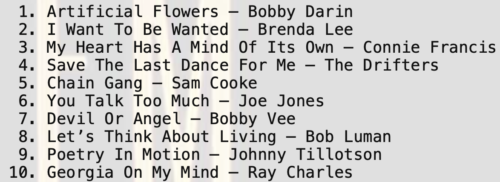
CKSO 790-AM Sudbury (ON) – The Big New CK Sound Soaring 79 | November 7, 1960
Leave a Reply