
#2: Linda Lu by Ray Sharpe
City: Saint Jerome, PQ
Radio Station: CKJL
Peak Month: October 1959
Peak Position Saint Jerome ~ #9
Peak position in Vancouver ~ #27
Peak Position on Billboard Hot 100 ~ #46
YouTube: “Linda Lu”
Lyrics: “Linda Lu”
Ray Sharpe was born in 1938 in Fort Worth (TX). He learned guitar, influenced by Chuck Berry recordings. In 1956, he formed his own trio named Ray Sharpe and the Blues Whalers, with piano player Raydell Reese and drummer Cornelius Bell. They became popular playing rock and roll in Fort Worth clubs. Early in 1958, Artie Glenn (the writer of “Crying in the Chapel” which became a number-one R&B hit for the Orioles in 1953) gave Ray the opportunity to record two demos, both self-penned songs. Glenn sent copies of the demo to various people, including Lee Hazlewood and Lester Sill. They invited Sharpe to come to Phoenix for a session on April 2, 1958. His recording career started when Lee Hazelwood produced his single, “That’s the Way I Feel” / “Oh, My Baby’s Gone” on the Hamilton label. Both Duane Eddy and legendary session musician and rhythm guitarist Al Casey were in the studio with Ray Sharpe for his debut recording.
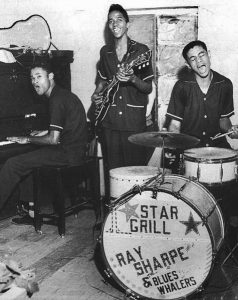
Ray Sharpe and the Blues Whalers (1958)
His first hit single was on the Jamie label titled “Linda Lu” and credited to only Ray Sharpe. The song was on the charts in various radio stations between June and October 1959.
However, at the May 18, 1959, recording session featured a rocked up version of “Red Sails In the Sunset”. This was a cover of the 1935 pop standard by Hugh Williams and Jimmy Kennedy that became a number-one hit for both Bing Crosby, and Guy Lombardo (and a #2 hit in 1935 for Mantovani). The rocked up cover was thought to have the best chance of becoming a hit. The reverse, “Linda Lu”, was an afterthought and very nearly not recorded at all. “Red Sails In the Sunset” was issued on Jamie and received favorable responses from the trade press and jocks. However, it didn’t start selling in sufficient quantities to indicate that a hit record was forthcoming. Suddenly, a DJ in Los Angeles started to play “Linda Lu” and things began to happen. Especially after Dick Clark included the song on his playlist for American Bandstand and made Sharpe part of his first rock and roll package Dick Clark’s Caravan of Stars on August 20, 1959 at the Hollywood Bowl.
This first Caravan of Stars event featured Frankie Avalon, Annette Funicello, Anita Bryant, Dody Stevens, Skip & Flip, Strangers, Duane Eddy, Freddie Cannon, Jan and Dean, Bobby Rydell, Jack Scott, Ray Sharpe, Jerry Wallace, the Young Lions. Clark’s Caravan set an all-time attendance record at the Bowl with over 5,000 being turned away. Variety reported that police set up loudspeakers six blocks away to tell people the show was sold out. (The Caravan of Stars would later be headlined by Paul Anka, the Drifters, the Skyliners and others, with Ray Sharpe and Jan & Dean among several recording artists dropped from the tour when it headed east).
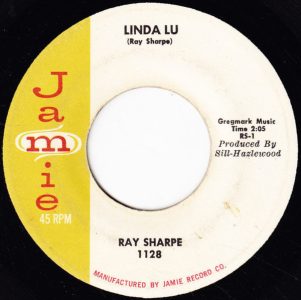
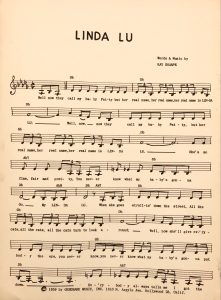
Ray Sharpe penned “Linda Lu”. He sings about a gal whose nickname is “Patty”, but “her real name is Linda Lu”. And he can never tell what she’s going to do. He brags “when she goes strolling down the street all the cats turn to look around.” He adds, “She’ll give everybody the eye” (the eye back to the cats – the guys – who are looking at her). Sharpe remarks, “you never know what my baby’s gonna put down.” It seems she has a bit of a roving eye. And as the boyfriend hangs out with others, he exclaims “everybody always tells me I’ve got the cutest little girl in town.” With all the cats taking a look at Linda Lu, he declares “I’m gonna marry that girl next Saturday night. Take care of her for the rest of my life. From now on my rovin’ days are through, and it’s all because of that chick, Linda Lu.”
This guy has big plans for a future with Linda Lu. However, it’s plausible that the way she gives “everybody the eye” is getting under his skin. In the final verse Ray Sharpe sings “Linda Lu what are you gonna do? I had a real bad dream last night honey, you said, you said, you said we were through. Now if you ever leave me you’re gonna break my poor heart in two, my Linda Lu.”
Let’s hope they made it to the altar.
“Linda Lu” reached #4 in Wheaton (MD), and Burlington (VT), #5 in Washington DC, #6 in Phoenix, New Britain (CT), and San Bernardino (CA), #7 in Peoria (IL), #9 in Sainte-Jerome (PQ), and Toledo (OH), and #10 in Detroit. It stalled at #46 on the Billboard Hot 100, but climbed to #11 on the Billboard R&B chart.
“Linda Lu” was one of many songs in the early rock era with female names as song titles. Others include “Mary Lou” by Ronnie Hawkins, “Mona Lisa” by Carl Mann, “Margie” by Fats Domino, “Marina” by Rocco Granata, “Little Coquette” by Jimmy Beasley, “Tina” by the Easy Riders, “Unfaithful Diane” by Don Deal, “Rosie Lee” by the Tunedrops, “Claudette” by the Everly Brothers, “Kathaleen” by Sonny James, “Mary, Mary Lou” by Bill Haley and His Comets, “Angela Jones” by Johnny Ferguson, “Vicki Lee” by the Untouchables, “Rosemary” by Brian Hyland, “Clementine” by Bobby Darin, “Gloria’s Theme” by Adam Wade, “Corrina Corrina” by Ray Peterson, “Shake Shake Sherry” by the Flairs/Redwoods, “Barbara Ann” by the Regents, “Oh Joan” by the Beau Marks, “Marcheta” by Karl Denver, “Judy” by Elvis Presley, “Cinderella” by Paul Anka, “Julie” by Jan & Dean, “Lana” by Roy Orbison, “Leah” by Roy Orbison, “Bonnie B” by Jerry Lee Lewis, “Ginny In The Mirror” by Del Shannon, “Patti Ann” by Johnny Crawford, “Along Came Linda” by Tommy Boyce, “Violetta” by Ray Adams, “Alice In Wonderland” by Neil Sedaka, “Connie-O” by the Four Seasons, “Donna Means Heartbreak” by Gene Pitney, “Mary Ann Regrets” by Burl Ives, “Peggy Sue” by Buddy Holly, “Donna” by Ritchie Valens”, “Hello Mary Lou” by Ricky Nelson, “Venus” by Frankie Avalon, “Cathy’s Clown” by the Everly Brothers, “Sherry” by the Four Seasons, “Diana” by Paul Anka, “Hey Paula” by Paul and Paula, “Runaround Sue” by Dion, “Sheila” by Tommy Roe, “Ramblin’ Rose” by Nat “King” Cole, “Maybellene” by Chuck Berry, “Sally Go Round The Roses” by the Jaynetts, “Long Tall Sally” by Little Richard, “Susie Darlin'” by Robin Luke, “Marie’s The Name (His Latest Flame)” by Elvis Presley, “Denice” by Randy and the Rainbows, and many others.
In January 1963, Sharpe remixed the song and issued a new release. It charted to #28 in Cleveland, #32 in Odessa (TX), #38 in Vancouver (BC) and #39 in Dallas. The original recording was rereleased in 1968 and charted in Stevens Point (WI).
“Linda Lu” has been covered by Al Saxon, Jimmy Gilmer & the Fireballs, Bobby Vee with the Ventures, Paul Revere & the Raiders, the Astronauts, the Standells, P.J. Proby, the Australian rock n’ roll band Billy Thorpe and the Aztecs, Gary Lewis and the Playboys, Sir Douglas Quintet, Johnny Rivers, the Flying Burrito Brothers, the Kingsmen, Johnny Kidd and the Pirates, Tom Jones, Little Eddie and his Starlights, Gee Gee Shinn, David “Honeyboy” Edwards, Johnny Otis, Sandy Nelson, Lee Greenwood, and others.
Sharpe’s followup on the Jamie label in October 1959 was the rockin’ “T.A. Blues” (T.A. being short for ‘teenage’) which charted modestly in Norfolk (VA) and Boston. The B-side, upbeat “Long John”, charted in Philadelphia, Cleveland, Atlantic City (NJ), and San Francisco. A third release on the label, “Bermuda”, made the Top Ten in Hillsboro (OR) and Batesville (AR) in March 1960. In the fall of 1960, Sharpe released “Kewpie Doll” which charted in the Top 40 in Tulsa (OK). Sharpe’s song was not a cover of the 1958 same-titled song by Perry Como. Sharpe’s “Kewpie Doll” was another rockin’ tune that got overlooked.
In the fall of 1960, Ray Sharpe recorded on Lee Hazelwood’s 3 Trey label with a tune titled “Justine”. It got airplay in Phoenix and in Ventura (CA).
Sharpe released more records on Garpax, Monument and Atco record labels. In 1966, he teamed up with The King Curtis Orchestra to record “Help Me (Get The Feeling)”. In the recording session a young Jimi Hendrix was playing on guitar. The single cracked the Top Ten in Buffalo, and charted in Detroit, Oakland (CA), Pittsburgh, and San Antonio (TX).
Ray Sharpe released one last single in 1971 titled “Another Piece of the Puzzle (Just Fell in Place)”. It told a story in the style of Clarence Cater’s “Patches” and O.C. Smith’s “Son Of Hickory Holler’s Tramp”. In this case, the boy’s father dies when he is a child. However, after his mother also dies he becomes a father. In that child’s eyes he sees the eyes of both his father and mother.
Ray Sharpe has continued to perform into his eighties in the Fort Worth (TX) area.
On his Wayback Attack website, Michael Jack Kirby notes, “As a white-sounding black rockabilly singer who plays a mean blues guitar, Ray Sharpe is somewhat unique in music history. Other African-American singers who fall into the rockabilly realm would be Billy “The Kid” Emerson, Big Al Downing, and possibly Ron Holden (if for no other reason than his manic “My Babe”).”
Dik de Heer, writing on his Black Cat Rockabilly website remarks, Ray Sharpe “was rediscovered by rockabilly enthusiasts in Europe and brought over to perform there. In the end, record sales and chart appearances have not made a lot of difference to Ray Sharpe. He is a masterful guitarist, above average singer and a seasoned entertainer with a repertoire of material so wide (R&B;, country, funk, pop, soul, blues and rock ‘n’ roll) that he can satisfy the needs of the most demanding audience.”
January 24, 2026
Ray McGinnis
References:
Ray Sharpe & The King Curtis Orchestra, “Help Me (Get The Feeling)“, Atco Records, 1966.
Dik de Heer, “Ray Sharpe,” Black Cat Rockabilly, 2012.
Michael Jack Kirby, “Ray Sharpe: Linda Lu,” Wayback Attack.
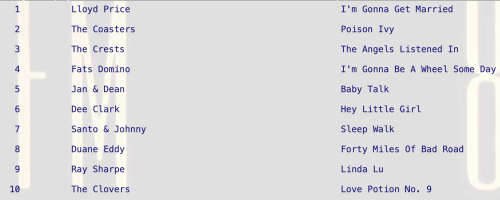
CKJL 900-AM Saint Jerome (PQ) | October 10, 1959
Leave a Reply